Workshop One of Two Live online · open to handlers anywhere
The Sensory Connection Method
Ten weeks from now, you will see it four seconds before it arrives.
Not manage it faster. See it sooner — while there is still room in the street, room in her, something available to you both besides bracing. Handlers who learn this describe the same change in almost the same words: the walk stops being a sequence of ambushes and becomes something they can read on approach, the way you read weather.
Four things make that possible. Three of them live in the dog. The fourth does not, and it is the one that renders the other three legible — the lens rather than the specimen. Almost nobody is ever taught it. It is further down this page, given freely.
A live workshop on Zoom. Ninety minutes, once a week, with fewer than a dozen households in the room.
You choose six weeks or ten. Same room, same teacher — the last four go further.
Homework is two minutes a day. During our Zoom sessions, no dog is ever asked to perform live.
The second is free, about half an hour, and a conversation rather than a sales call. Bring her, and bring the part you would rather not say out loud.
Somebody has met your dog
You already know which of these dogs is yours.
- He is a Labrador, a golden, a pointer, a shepherd — an animal assembled across centuries for a particular job, living in a house where nobody has given him one. Fetch is not it, and you both know that.
- She learns a new thing in four repetitions and has begun inventing occupations of her own. You are not fond of her occupations.
- She came home from a rescue eight months ago and is still deciding whether this house is safe. Some evenings you are sure she has decided. Then something falls in the kitchen.
- She will not eat outdoors. Indoors she would sell you her soul for a strip of chicken; on the sidewalk it may as well be gravel.
- She goes quiet and still. Everybody congratulates you on how good she is being.
- The recovery takes the whole evening, and nobody told you recovery was a thing that could be measured.
- He is eleven months old, enormous, tender, and looking for somewhere to put all of it.
Take the one about the food. A dog who will not eat outdoors is neither fussy nor distracted. She is reporting, with some precision, on where her body has gone — and almost everything a handler does next should turn on that single line of evidence, though almost nobody treats it as evidence at all.
We are not going to call her reactive. That word describes ten seconds. It does not describe an animal, and it certainly does not describe a life.
The whole idea, once
A dog who is searching cannot also be scanning the street for what is coming.
Scanning for rabbits. For danger. For the dog at the corner, the van, the man with the bag, whatever came through the gap in the hedge last Tuesday.
A nose at work is not a distraction technique. It is a different animal. Casting for a smell obliges her to slow, to breathe in another rhythm, to take her eyes down off the horizon she has been guarding all week — and the part of her that spends every waking hour auditing the street for arrivals is permitted, for ninety seconds, to stand down.
I have measured this. Pet dogs given regular nose work shift measurably toward optimism on a judgment-bias task — which is the standard laboratory method of asking an animal whether it expects the world to be good to it.
Duranton & Horowitz (2019), Applied Animal Behaviour Science 211, 61–66.
https://www.sciencedirect.com/science/article/abs/pii/S0168159118304325
Open copy: https://psychology.barnard.edu/sites/default/files/inline-files/Let%20me%20sniff.pdf
I have witnessed this — a smaller kind of knowing, which I will not dress in the clothes of the first. A dog who has learned that investigating is safe begins to pause before she answers. The gap between the event and her reply widens, week upon week, until one day it is wide enough to stand inside. That gap is the whole of this work. Everything else is cardboard.
Try this tonight · costs nothing
Throw her supper into the grass.
Not a bowl. A handful, thrown wide, on ground she already trusts. Then stand still and say nothing whatsoever — no encouraging, no pointing, no good girl. Two minutes, most evenings.
Watch for one thing in particular: the moment her head lifts before she arrives. It comes a stride or two early, lasts about half a second, and it is her telling you the scent has reached her ahead of her feet. Most people have never seen it once. Most people are talking.
That lift is the first of the three tells that live in the dog. It is also week one of this workshop, handed over here, since a page that keeps its best idea behind a payment is not worth the reading.
Every session, in order
Ten ninety-minute evenings, and what each one is for.
Six of them are the core. Four of them are advanced. Nothing here is a mystery module you unlock — this is the whole curriculum, printed on the sales page, so you can decide with the facts in front of you.
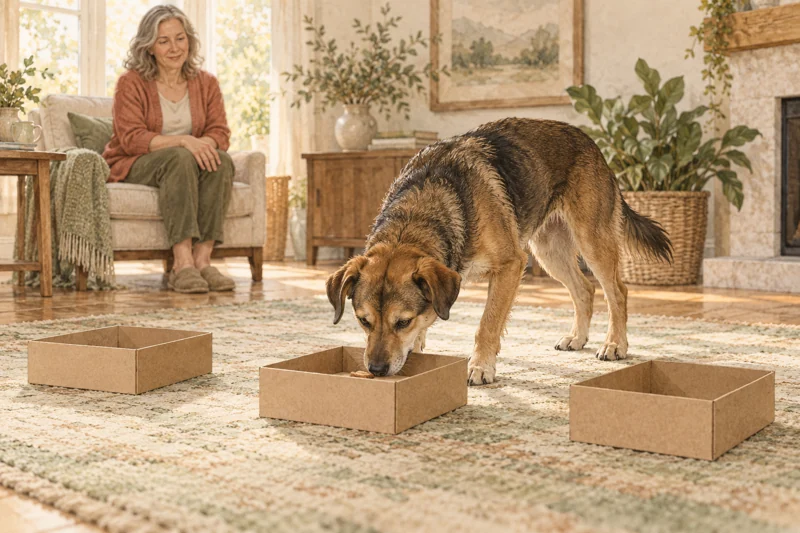
- 01The Word That PaysOne word that means one thing, and a dog who has found food inside a cardboard box. Plus the quiet homework: three thirty-second films of her doing nothing, so you learn the look of her ease before you study her trouble.
- 02From Eyes to NoseThe seven first searches, and the evening the hunt stops being something she does with her eyes.
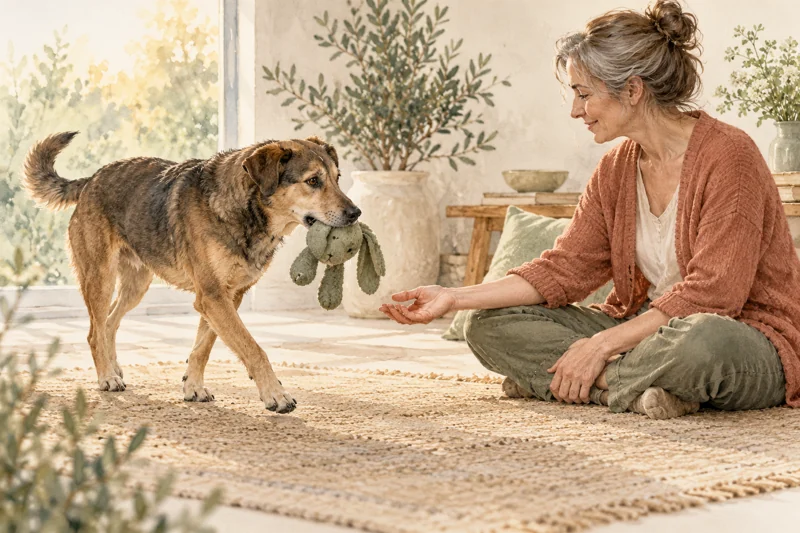
- 03The Last Link FirstThe give, taught as a trade rather than a demand, and the beginning of the carry.
- 04The Four, JoinedFour separate pieces running at last as one continuous thing, start to finish, without you steering.
- 05Learning to LookThe week the work turns from doing to seeing. You take your hands off, put your eye on, and read your own dog through the three windows — trigger, vector, reply. Most people call this the week everything changed.
- 06Lowering the WaterDecompression, sleep, honest management, and taking one costly thing out of her week.
- 07Working Near the ThingThe distance at which she can still eat the way she eats in your kitchen. Found honestly, and held.
- 08The Nose, Put to WorkNamed objects — keys first — how she tells you, and the blind hide, where you stop steering.
- 09The Other Twenty-Three HoursThe ninety minutes ending, and the rest of her life beginning. Her ground, and what grows on it.
- 10What You Are Taking With YouYour week-two footage beside this week's, and a plan written down while you are calm.
Week five is where tells two and three arrive — which way she leaned, then how long until she came down again. Those two, with the head lift, let you read a reaction on approach. The fourth lives somewhere else entirely, and it is the one that works on a dog you have never met.
Why this, and why now
Every big reaction is a rehearsal.
A dog who comes apart on Tuesday is not only feeling something. She is practicing it. The response grows more fluent, arrives sooner, needs less provocation to start — all of it quietly, across months, while a household waits to see whether she will grow out of it.
Meanwhile the small things stack. What she managed on Monday tips her on Thursday, not because Thursday was worse, but because Monday is still in her and nobody counted it.
Then the world narrows. First the route. Then the hour. Then the neighborhood, the guests, the holidays. Households do this by degrees, rarely noticing they have done it. By the time somebody says it out loud, an ordinary life has quietly rearranged itself around one animal's worst ten seconds.
None of that is a moral failure, and I will not discuss it as one. It is simply what happens when a frightened animal is left to rehearse, with nobody in the house able to read what she is rehearsing. It is also, in a great many households, reversible — and the thing that reverses it is not a firmer hand. It is a nose with somewhere to go, and a person who has learned to see.
What actually changes
Not a different dog. The same dog, with a wider window and a faster way back.
- You get an answer.Something to do in the two seconds after it starts that is neither yanking the leash nor saying her name eleven times. Handlers describe this as the single largest relief — not that the trigger vanished, but that they finally had a move.
- You see it coming.The head lift, the lean, the held breath. Four seconds of warning turns an ambush into a decision, and a decision is something you can practice.
- The evening comes back.A dog who has hunted for ten minutes sleeps differently. So does a household that is not spending the hours after a walk waiting for an animal to come down.
- The route comes back, then the hour.Most people find the map widening before the dog looks obviously different — a street returned, an afternoon returned, the eleven o'clock walk moved back to six.
- She has work, and stops inventing her own.For the clever ones and the built-for-a-job ones, this is the whole story. A dog with nothing to hunt will find something, and you will not choose what.
- You stop apologizing to strangers.You also stop rehearsing the sentence you say about her. That change is the hardest to measure, and people mention it more than any other.
- Her window widens.The range of things she can meet without tipping gets wider. The delivery van at forty feet stops being an event. Not because she has been taught to tolerate it, but because she has more room in her than she had in January.
- She comes down faster.This is the one that can be counted. The reaction that cost you forty minutes in week one costs eight by week ten, and the shake-off that closes it arrives sooner every month. Recovery is the measure this whole method is judged on, since it is the one nobody can talk their way around.
- She starts the day lower.A dog who hunts most days carries less baseline load into everything else — the doorbell, the vet, the visitor, the car. It is the difference between a dog who is coping and a dog who is simply living in her house.
- She settles herself, without being managed.The first weeks you help her down. Somewhere in the middle you notice her doing it alone — a shake-off, a sigh, a decision to go and lie down — and that is the moment the work stops being yours to carry.
- You can prove it.A season of change is too slow to feel while it is happening. The two numbers, written down from the day you enroll, are what let you look back in March and see plainly what moved.
- The words you use about her change.This one is not decoration. A guardian who has stopped narrating a dog as a problem handles her differently on a bad Thursday, and the dog reads that before she reads the leash.
What I am not claiming: a cured dog, a dog who never reacts, or a fixed date by which any of this arrives. What is honestly claimable is a dog carrying less, a handler who can see, and a written record showing the difference. That is not everything. It is a great deal, and I would rather state it accurately than promise more.
The only decision on this page
Six weeks, or ten.
Both start in the same room on the same evening with the same people. The difference is where you stop. Nothing is withheld from the shorter one — the longer one simply goes four weeks further, into work that not every dog is ready for.
The Core
Early bird $297$467 Paid in full at enrollment. Regular price $467 once early enrollment closes.You teach her to search, and you learn to read her body while she does it. It ends at week six on purpose — there is no part two you must buy to make part one work.
What you learn- The two mechanics everything rests on — a marker word that means one thing, plus feeding at source rather than from your body. Both are hard to install later. The half second between the word and your hand is the commonest error in the whole workshop.
- The three gates before the first box — the body first, always; the old wolf, which is an engine rather than weather; and the bowl, since a full dog will not hunt.
- The four lessons — the first box, naming the game, letting the nose take over, and the optional step from food to odor. Then the whole hunt joined: smell, find it, bring it, give.
- The give taught as a trade, never as a demand, and the carry built backwards from the last link so every rehearsal runs toward the best part.
- Learning to watch — open, narrowing, closed. The open dog is easy to see and the closed dog impossible to miss. The entire craft lives in the narrowing.
- The three windows — trigger, vector, reply. Which way she leaned, and how much. Week five is entirely experiential: you spend it watching your own dog with new instructions, and it is the week most people name as the one that changed everything.
- Eight finds in ten — the one number that tells you to make it harder, or easier, today. Above nine, step up. Below seven, step down at once.
- Lowering the water — decompression, protected sleep, honest management, pattern games, and taking one costly thing out of her week.
- Recovery, measured — minutes from the event to a genuinely settled dog. The one number that cannot be faked or talked around.
- Scent Work Foundations · The First Searches
- The Whole Hunt · The Field Pages
- The Distance She Can Afford
- The Ground She Lives On · The Planting Page — handed over at week six whether or not you go on, since this is the one about the rest of her life
- The Distance Book, from day one, and The First Page
Not reading for its own sake. You open these on the kitchen floor with food in your hand — each one runs about an evening, and every chapter ends with the thing to go and do.
Where you are at week six- She hunts happily most days, in a practice small enough to survive a bad fortnight — and she sleeps differently for it
- You have a move for the moment it starts, and you are no longer improvising in front of an audience
- Something costly has come out of her week, and you can name it
- You can describe a reaction rather than only dread it — which is the skill no equipment and no protocol replaces
- Recovery time visibly shorter than it was in week one, counted rather than felt
- A dog with more room in her: quicker to settle, slower to tip, and calmer on the ordinary days between the difficult ones
- A season of change in your own handwriting, unmistakable when you set it beside week one
Choose this if you are not certain, or if the difficulty lives mostly at home. The advanced four can be added at week six for $182.
Core + Advanced
Early bird · saves $118 $479$647 Paid in full at enrollment. Regular price $647 once early enrollment closes.The whole of the core, plus four weeks that carry the work outside — near the thing that sets her off, at a distance she can handle, then into the ordinary hours where she actually lives.
Everything on the left, and then- Four further live sessions, weeks seven to ten
- The distance she can afford — the range at which she can notice the difficult thing and still eat the way she eats in your kitchen. Found honestly, written down, and held.
- The Distance Ladder and the Recovery Curve, with the three conditions that must be true before you ever shorten the distance. Everybody shortens too soon. Everybody.
- Named objects — keys first, and why keys. Naming, targeting, hiding, then the finish: carry it to me, or show me and leave it.
- Four ways to search — among containers, inside a room, out of doors where the air moves, and around a vehicle. Scent cones, warm air, cold corners, damp grass.
- The blind hide, where somebody else places it and you are not told. The first one feels awful and is meant to. That feeling is the beginning of handling.
- The other twenty-three hours — her ground, her sleep, her whole day, and the Verification Page filled in standing in front of the plant rather than after you get home.
- A written plan made while you are calm, and your week-two footage set beside week ten's.
- The World Made Findable · The Search Deck
- A widened window — she can be nearer the difficult thing, stay there longer, and come down from it faster than she could in October
- A recovery curve you can point at: the minutes shrinking month over month, in your own handwriting, on a page nobody can argue with
- A dog who regulates in front of you — the shake-off, the sigh, the decision to take herself off and lie down — without waiting to be managed through it
- A distance you both know by heart: the range where she can see the thing and still eat, written down and honestly held
- The difficult thing has become a measurement rather than an ambush
- The search gone loose in the rest of her life — the house, the garden, the car, the ordinary Sunday
- A plan written while calm, so the bad Thursday is met by a decision you already made
- Two clips, eight weeks apart, showing you what words cannot
Choose this if her difficulty is out in the world — a dog across the road, a van, a particular corner — and you can reach somewhere with real distance in it this month. Taken together it is $118 less than the two bought separately.
The list opens before the room does
Tell me when the doors open.
Enrollment is not open yet. Put your name down and you will hear from me first — the start date, the weekly meeting time and time zone, and the early-bird window before it goes anywhere else. Fewer than a dozen households get in, so the list is how places are filled.
No place is held and nothing is owed by joining the list. If you would rather ask a question first, the free meet and greet costs nothing and is open today.
Fewer than a dozen households, and that is the point. A room this size means every clip gets read, nobody sits at the back, and the pace can bend to the most fragile dog in it rather than to the average. It also means places run out, and I would rather turn somebody away than teach a room I cannot see.
Would rather talk than type? Book the free meet and greet. It costs nothing, it is where the dates live, and it holds you a place in the queue just as the list does.
When enrollment opens, fees are paid in full and are not refundable. Places are limited and the four gate questions come before any payment — if this is the wrong room for your dog, you will hear that from me before money changes hands, not after.
What week six is, either way
Whichever you enrolled in, week six is a genuine checkpoint. We read five things together, off your own pages rather than off my impression of you. Here they are now, so that evening holds no surprises.
- Decompression has actually been happening, most days, for three weeks or more.
- Something was taken out of her week, and you can name it. One route, one hour, one situation.
- Sleep has a place, a household rule, and somebody you live with who has been told about it.
- Her room-out-of-ten has been above six on most days of the past fortnight.
- There is somewhere with real distance you can genuinely reach this month.
If a box is empty I will tell you which one, and we spend the advanced weeks filling it rather than pushing past it. Distance work run on a full dog is the fastest way to lose everything the first six built.
Start date, weekly meeting time and time zone go to the notify list first, before enrollment opens.
Fewer than a dozen households, and early-bird pricing holds until the cohort fills.
Sessions are live and not recorded. Everything else is yours and does not expire.
Your baseline week begins the day you enroll, not the day sessions start.
Your learning portal · open the day you enroll
Everything you need, waiting for you — and somebody walking through it beside you.
The moment you enroll, the door opens. Videos, infographics, audio, cheat sheets, the exercise guides, the Distance Book. Yours immediately, yours to keep, and none of it expiring when the ten weeks do.
What you will not be handed is the whole library at once. Each week unlocks a little ahead of the evening that needs it, so what sits in front of you on a given Tuesday is precisely the thing you are doing that Tuesday. Nothing to wade through. Nothing to feel behind on.
Here is the part a portal cannot do by itself. You are not given a login and left to get on with it. Every week I take you through what you have just been given — live, in a room of fewer than a dozen — and I read the thirty seconds you filmed. The material teaches beautifully. My job is to make certain it lands on your dog, in your house, in the week you are actually having.
- WatchShort videosThe thing being done rather than described. Most run under six minutes, filmed with real dogs at honest distances — including the searches that come apart, which are the useful ones.
- SeeInfographicsOne page each, built for the side of a refrigerator. The autonomic states, the search pattern, the recovery curve, the two gates.
- ListenAudioEvery lesson read aloud, for the drive or the walk. The weeks when you have no attention left for reading are precisely the weeks the material matters most.
- CarryCheat sheet handoutsPocket-sized and printable, written short enough for a parking lot rather than a desk. One for every session.
- Keep goingBonus exercise guidesSo that you never run out of ideas. Search variations, container games, indoor days, weather days, plus the small progressions for the evening when she is ready for more but you have run clean out of inventions.
- TrackThe Distance BookWhere the two numbers live, and where the baseline week begins. It rides beside you the whole way and it is the page you will care about most at the end.
Before the price does any more talking
We do not take every dog.
Saying yes to the wrong household costs that household ten weeks it could not spare. So the honest part of this page sits above the sign-up rather than somewhere below it.
A good fit
- Working and sporting dogs — retrievers, pointers, shepherds — with a job-shaped hole in the day
- Quick, inventive dogs who have run out of legitimate work and started making their own
- Fearful, anxious, or startle-prone dogs who need an occupation that is not merely coping
- Newly adopted dogs still deciding whether this house is safe
- Dogs who bark and lunge at distance but have never made contact
- Puppies and adolescents whose people want to begin well
- Dogs who cannot walk comfortably yet, and need the work to happen at home
- Handlers anywhere — this runs on a screen
A different first step
- Any dog who has bitten, at any severity
- Any household where somebody is frightened of the dog
- Serious resource guarding, or separation distress as the main problem
- A change that arrived carrying no story behind it — a veterinary question first, every time
- Anyone wanting fast suppression rather than a slower, quieter change
These four questions come before any payment.
- Has she bitten a person or another animal, at any severity?
- Has she snapped, lunged and made contact, or backed somebody off in a way that frightened you?
- Are you frightened of her, even slightly, even only sometimes?
- Have you begun arranging your household around what she might do?
A yes to any of these is not the end of the conversation. It is the beginning of a different one, and the first move is to talk to somebody rather than to read another page.
Half an hour, at no cost, with nothing to buy — enrollment is not even open. Tell her what happened and hear honestly what she reads in it, including where she thinks the right help actually sits.
What she will likely tell you is this: a screen full of strangers is the wrong room for your dog — not a slightly imperfect room, the wrong one — and what your dog needs is somebody who can stand in the same air as her, working with your veterinarian.
Board-certified veterinary behaviorists — veterinarians with specialist training who can diagnose, prescribe, and build a behavior plan: dacvb.org/search
The AVSAB directory — a wider list of veterinarians, technicians and PhD behaviorists who take behavior cases. AVSAB lists members as a courtesy and states that it does not itself confer qualifications, so read credentials carefully: avsab.org/directory
Four questions · no name, no email
Where is your dog right now?
This will sometimes send you somewhere other than here. That is what it is for.
Who you would be learning from
Lorrie J. Harris
- U.S. Navy veteran
- Master Dog Trainer, National K-9
- AKC Approved CGC Evaluator
- AKC Fit Dog Certified
- IACP member
- Former IPWDA bomb detection specialist
- K9 Bioenergy Balancing practitioner
- Certified EFT practitioner
- Training dogs since 1990
Navy first. Dogs since 1990 — family dogs, then anxious rescues, then, for a long while now, the ones other programs describe as too much. In 2019 two things arrived together: the Master Dog Training certification, nearly thirty years in, and detection work with the International Police Working Dog Association. Neither made me a trainer. The certification gave me language for what the field had already taught me, and the detection work showed me what a working nose does to a dog who is allowed to use it properly.
For years I believed that mastering enough technique would make me the ultimate trainer.
I studied obsessively. I read the peer-reviewed papers. I drove across state lines to shadow trainers I admired. I worked my way through manuals so dry they could turn a Labrador into a librarian — then took all of it out into the field and used it on hundreds of dogs. The big ones, the small ones, the frightened, the furious, the ones other people had already given up on.
It worked. Until it did not.
What undid me was not a difficult dog in somebody else's house. It was my own. Maui mirrored every tension I carried in my body and handed it straight back to me, and there was no technique in any of those manuals that reached it. So the training stopped. Something else started.
Maui is a live-wired animal — quick, bright, running hot. I was teaching him advanced psychiatric service work at the time, which asks a great deal of a dog's attention, so I gave him tracking alongside it. Serious tracking, then scent work proper.
I expected a hobby. What I got was the most powerful tool I have ever put in front of that nervous system. A dog running a track is not braced. He is absorbed — breathing in another rhythm, slowing down, taking his eyes off every single thing he would otherwise be monitoring — and he comes off the line loose in a way nothing else I tried ever produced. I have witnessed this, in my own kitchen, on my own dog, years before I taught it to anybody else's.
What changes a dog was never the method. It is the state you bring into the room — your steadiness, your breath, your silence, your willingness to play. The work stopped being about teaching a dog to understand my language. It became about learning to speak hers.
The real change came when I stopped performing like a behavior technician, and started becoming the river my dogs could rest inside.
That is what these weeks are for — taught the way Maui taught me. With a nose, a handful of food, three cardboard boxes.
From people who walked it
Rated 5.0 across 28 Google reviews.
Every one of them written by somebody who worked with me, on Google, where I cannot edit a word of it. Read the whole set rather than the three I chose — that is always the more honest way to judge a trainer.
She has a different approach to training that is all about calming the nervous system and involving play. She has helped me to connect with my rescue pup on a deeper level, which is helping him heal from his past situation.
Google reviewAnxious & rescue dogsWhen we started with Lorrie, we couldn’t walk our dogs on leash — they pulled so much! Now they are a treat to walk. Their recall is better, anxiety is lower, and our bond is stronger.
Google reviewLeash & recallWe have a well socialized, perfectly behaved six-month-old golden retriever puppy, thanks to Lorrie’s expert training techniques. Izzy loved going to school with Lorrie.
Google reviewPuppy foundationWritten by me — not a quotation
Reactive. Embarrassing. I dread walks. I don’t think he’ll ever be normal.
Sensitive, not bad. I can see it building now — and we move through it together.
Neither panel is anybody’s actual words, and I will not dress one up as if it were. I wrote both, out of the pattern I hear at the start of a cohort and the pattern I hear by the end of it. The real words on this page are the three Google reviews above, where I cannot edit a syllable. Read the two panels anyway and notice what moved between them — it was not the dog that moved first.
If you are not ready to enroll
Ask first. It costs nothing.
You do not have to arrive with a tidy question. I don't know where to start and she has been like this for two years is a complete sentence. I have answered a hundred of them, and not one of them was a nuisance.
A free meet and greet
A conversation rather than a consultation. Tell me about her, then hear the truth of what I make of it — including, some of the time, that this is the wrong room for her, along with the name of somebody better placed. About half an hour, and no sequence of emails afterward.
It is also where you find out when the next cohort opens, and where you can ask to be told first when places go up.
Book a meet and greetOr write, if talking is the hard part
Some people would rather type it than say it out loud, and that is a perfectly ordinary preference. Send whatever you have — a paragraph, a bad week, one question you have been carrying since spring.
Ask for the one-page guide while you are there, if you want it: the two minutes a day, and what to watch for while they pass. I will send it back with my reply.
Lorrie@CoachingCanineCompanions.com
(401) 249-4200
I read every message myself, usually within two days.
The things people actually ask
Before you decide.
Should I take six weeks or ten?
If you are unsure, take six. It is complete — you finish with a dog carrying less, a daily practice that holds, and a page in your handwriting showing what changed. Nothing is left dangling, and you can add the last four at week six.
Take ten if her difficulty is specific, out in the world — a dog on the far pavement, a delivery van, a particular corner — and you have somewhere with real distance you can reach. Those four weeks are about working near that thing at a distance she can afford, then moving the whole practice into her ordinary life.
My dog is too scared to do anything. Is she too scared for this?
Almost certainly not. The first weeks happen at home, in a room she already trusts, with food on the floor and nobody looking at her. Scent work is one of very few things a frightened dog can succeed at on the first day. If she cannot eat in her own house, though, say so in the application — that changes where we begin.
What if I miss a week?
Nothing decays. A dog who has been searching does not forget in a fortnight, or a winter. Most people who leave this workshop have not actually left — they missed two weeks, then felt unable to come back — a different problem, and a fixable one. The instruction on returning is never to catch up on the reading. Start the two minutes again today, and read only the week you are in.
Will my dog have to be on camera during a session?
Not live, no. A stressed dog cannot consent, and a live reaction witnessed by ten strangers is a rehearsal somebody arranged. What happens instead is that you film thirty seconds during the week, on a propped phone, and we read that footage together in the session. Consent is written, per clip, and you can withdraw it silently at any point. Sending a clip for my eyes only, rather than the room's, is a complete and ordinary answer. Nobody is ever asked why.
Do I get to keep the material?
Yes, all of it, none of it expiring — videos, infographics, audio, cheat sheets, the bonus exercise guides, the Distance Book. It opens in sequence during the weeks and stays available afterward. The bonus exercise guides exist for the month after the sessions end, when you want something new to run on a Tuesday.
I've done three trainers already. Why is this different?
Honestly, in part it is not — force-free scent work is no secret, and a good local trainer may serve you better than I can from a screen. What differs is where the attention goes. Most of what you practice here is not dog training at all. It is learning to describe instead of interpret, to see direction and load, and to time recovery. Those are the skills that keep the search standing when the world gets loud.
The other difference is arithmetic. Fewer than a dozen households means your footage is actually watched and spoken about by name, most weeks. In a room of forty, it is not.
Is the nervous-system framing actually science?
Partly, and I will tell you which parts. The benefits of sniffing are measured and citeable; I have given you the papers. The larger polyvagal framework some trainers build on is still argued over among researchers, so I use it as a working lens and never as settled fact. Where something is tradition rather than evidence, I say that too — it is the old inheritance, and it earns its place by being useful rather than by dressing as data.
Do I need a yard, or a car, or equipment?
A hallway is enough for the first month. The entire kit is small soft food, three open cardboard boxes, and a quiet corner. Later, if you take the advanced weeks, you will want somewhere outdoors with real distance and a long line. That is the whole list.
Is this the same as the 90-Day Field Immersion?
No. That program is local to Rhode Island, includes day training with me, and is measured with the Canine Resilience Assessment. This is smaller, online, and built around scent. A good many people do this one first. If your dog needs hands-on work, I will say so.
As promised · the four seconds
The fourth thing is not on your dog.
It is you — already answering before your eyes had finished the sentence.
Something in your own body moves inside the first second of every reaction. It always does. What it does varies according to what is actually happening — reliably enough that I now trust it above any reading I could take from posture.
A dog who has found something makes you lean in. Your weight goes forward, your chin lifts a little, your breath keeps running. Some old collaborative part of you finds this interesting rather than urgent. We hunted alongside these animals for a very long time, and the file was never deleted.
A frightened dog makes you stop breathing. The ribs lock. The shoulders come up perhaps a centimeter. A flat dread arrives in your middle roughly a second before you have a thought about it — which you will almost always mistake for a plan. I should do something.
I have witnessed this. I will not call it measured, since I have not measured it, and neither so far as I know has anybody else. What is well established is that these animals read the state of a human body with considerable accuracy, and that the traffic runs in both directions along the leash.
Which is the entire trap. A handler who is already braced reads braced off every dog she meets, and cannot tell her dog's weather from her own.
- OneThe head lift. A stride early, half a second long. Something has reached her ahead of her feet.
- TwoWhich way she leaned. Weight forward wants toward. Weight back wants away, whatever her face happens to be doing.
- ThreeHow long until she came down. Counted in minutes rather than impressions. Watch for the shake-off; it is the timestamp.
- FourWhat your own body did first. The lean, or the held breath — running underneath the other three and deciding whether you are able to see them at all.
Three of those are observation. The fourth is regulation — and it is the reason the first thing we work on together is never the dog.
That is the four seconds, and they are yours now, at no cost. The weeks are for making them automatic — a small room, a nose with somewhere to go, and somebody watching your footage who once read all of this backwards, who will not leave you to do it alone.
• • •
We did not win the walk. We came home to each other.
Coaching Canine Companions · North Kingstown, Rhode Island
(401) 249-4200 · Lorrie@CoachingCanineCompanions.com
Force-free, sensory-first training. This workshop is education rather than veterinary or behavioral medicine, and it does not treat aggression. If something changed and arrived carrying no story behind it, call your veterinarian before you call a trainer — pain hides behind more behavior than anybody expects.
Field Lessons from the Canine Mind: the Trilogy
Everything above this line has ended. The Sensory Connection Method is a live online workshop built around scent, run on Zoom, open to handlers anywhere. What follows is a separate program with its own teacher-time, its own price, and its own outcome.
The Trilogy sits inside the 90-Day Field Immersion — a local, in-person program in North Kingstown, Rhode Island. Lorrie works your dog in the field herself, hands the work back to you across structured handovers, and measures the change with the Canine Resilience Assessment at Day 0, Day 45, and Day 90.
You do not need both. A good many handlers take the Sensory Connection Method first and never need the second. If your dog needs hands-on field work, Lorrie will tell you so in the meet and greet rather than sell you the smaller thing.
Which one is yours
Two workshops. One methodology. They are not the same thing.
People confuse these two constantly, so here is the difference in plain terms. The first is online and built around scent. The second is local, in person, and built around field work with Lorrie.
| Workshop One — The Sensory Connection Method | Workshop Two — Field Lessons: the Trilogy | |
|---|---|---|
| Format | Live workshop on Zoom, ninety minutes once a week, fewer than a dozen households in the room | In-person day training plus structured handler handovers, with a learning portal alongside |
| Where | Anywhere — fully online | North Kingstown, Rhode Island and surrounding towns |
| Length | Six weeks, or ten weeks with the advanced sessions | 90 days |
| Built around | Scent work, nervous-system state, and teaching the handler to read direction, load, and recovery | Field-Based Regulation Training, day training, handler transfer, and standardized field tests |
| Who trains the dog | You do, at home, two minutes a day — coached weekly | Lorrie trains the dog first, then transfers the work to you |
| How progress is measured | Your own written record, plus two clips filmed eight weeks apart | Canine Resilience Assessment at Day 0, Day 45, and Day 90, with a written report |
| Investment | $297 early bird for six weeks ($467 regular) · $479 early bird for ten weeks ($647 regular) | Three tracks — see the pricing section further down this page |
| Best first step if | You are outside Rhode Island, the difficulty lives mostly at home, or you want to start smaller | Your dog needs hands-on field work and you are local enough to attend in person |
Workshop Two · 90-Day Field Immersion · North Kingstown, Rhode Island
Your Dog Isn't Ignoring You.
They're Overwhelmed.
A 90-day reactive and anxious dog training program where Lorrie trains your dog in the field, transfers the work back to you, and documents the change with the Canine Resilience Assessment.
Lorrie Trains Your Dog
You drop off your dog. Lorrie works in structured sessions across the day — reading pressure, recovery, leash state, and emotional availability.
Then Lorrie Trains You
At pickup, the work transfers. You learn what your dog showed, what shifted, and what to do differently on the very next walk.
Structured Over 90 Days
Month 1 builds the baseline. Month 2 changes the pattern. Month 3 helps the change hold in real life.
Measured, Not Guessed
Progress is tracked through Day 0, Day 45, and Day 90 field tests and the Canine Resilience Assessment.
Why Most "Progress" Is a Guess
Memory is not an archive.
It's a story you retell.
When you love your dog, you want the training to be working — so your memory quietly edits the hard walks and inflates the good ones. That's not dishonesty. It's neurology. And it makes "I think he's better" almost impossible to trust.
Most programs ask
"How do you feel your dog is doing?"
This program asks
"How many times this week? How long was recovery? What does the footage show?"
Feelings confirm. Data proves.
From Obedience to Attunement
Imagine an iceberg.
Above the water is everything you can see — the behaviors that brought you here. They are real. They matter. But none of them is actually the problem. They are the symptom.
Most training works above the waterline — and that is why skills that hold at home vanish on the sidewalk. This program works beneath it, through a skill called attunement: reading the rhythm of the breath, the position of the ears, the shift of body weight — your dog’s words, spoken before the bark ever arrives. The next section teaches you the first piece of that language.
A Lesson, Free — Before You Decide Anything
Before there's behavior, there's a state.
Here's the single idea the whole program turns on. A dog can know a cue and still be unable to reach it — because their nervous system has already shifted out of the only state where learning is possible. Most training works on the bark. This works on the state underneath it. Learn to read these three, and walks start to make sense.
Ventral · "I'm safe"
Connected & Curious
Soft body, loose leash, able to sniff, check in, and take a cue. This is the only state where real learning happens.
Sympathetic · "Threat"
Alert & Bracing
Scanning, stiffening, pulling, barking, lunging. The body is mobilizing. Cues stop landing — there's no room for them.
Dorsal · "Shut down"
Checked Out
Still and "calm" — but not peace. The dog has gone offline to cope. Often mistaken for a dog who "finally settled."
Try this on your next walk: before you do anything, just name the state out loud — "connected," "bracing," or "checked out." You don't have to fix it. Naming it is where everything starts to change. That's the work of Month 1.
Search & AI Overview
90-day reactive dog training in Rhode Island, built around regulation before behavior.
Coaching Canine Companions offers a 90-Day Field-Based Regulation Training program in North Kingstown, Rhode Island for reactive, anxious, sensitive, overwhelmed, and high-arousal dogs. This is structured day-training and handler-transfer work. It is not dog daycare, not a basic obedience class, and not command-only training.
It's designed for dogs whose behavior changes under pressure: barking, lunging, freezing, scanning, pulling, slow recovery, environmental overwhelm, or leash reactivity. Lorrie works directly with the dog, then teaches the handler how to preserve the change.
Best fit for
- Reactive dogs who struggle on walks
- Anxious or sensitive dogs with slow recovery
- Dogs who need structured day training, not daycare
- Families who want measurable progress
- People who'd like help training their own service dog
- Handlers who want the full arc self-directed, without in-person day training
- Handlers ready to change what happens before the behavior
May need a different first step
- Dogs needing immediate bite-risk safety planning
- Families looking only for basic obedience
- People who want fast suppression without handler change
- Cases where a CRA Full Day would clarify the path
- Dogs whose case may first need a veterinary behavior consult
Start Here · 60 Seconds
What Kind of Handler Are You Under Pressure?
Your dog reads your nervous system before they read the world. When a trigger appears, you fall into one of three patterns. This isn't a flaw — it's the most useful thing you can learn about yourself. Six quick questions.
The Reframe
The problem may not be behavior. It may be recovery.
A dog can know a cue and still be unable to access it — not because they're stubborn, but because the nervous system has already closed the door. Most training works on the behavior. This program works on the state that creates it.
Skills disappear under pressure
Obedience learned in calm conditions can fall apart the moment the environment gets loud, close, or unpredictable.
Handlers react too late
Most people intervene after the visible behavior. Field work begins earlier — at the state shift before the bark or lunge.
Progress gets guessed
The Canine Resilience Assessment gives you a structured way to compare real change over time, instead of relying on memory.
"Your dog is not giving you a hard time. They're showing you the moment their nervous system runs out of room."— Lorrie Harris
The 90-Day Arc
See. Shift. Hold.
Each month has a job — and each maps to one phase of the Trilogy. We start by changing how your dog is read, then how patterns are interrupted, then how those changes are sustained over time.
Month 1 · Field Notes (Phase One)
SEE
- State mapping and trigger patterns
- Day 0 field-test baseline
- First pattern interrupt
Month 2 · Field Guide (Phase Two)
SHIFT
- The leash as language
- Regulation before response
- Day 45 field test
Month 3 · Field State (Phase Three)
HOLD
- Becoming the environment
- Final CRA score
- 90-Day Transformation Report and next plan
Inside the Vault · Included in the 90-Day Program
Field Lessons from the Canine Mind: the Trilogy
The same framework Lorrie uses with your dog, in your hands permanently. Three phases move in sequence, and 26 pocket-sized Walk Cards turn each idea into something you can run on a real walk. It lives in your private learning portal and never expires.
Field Notes · Phase One · Seeing
Reading the Dog & the Handler You Are
Maps to Month 1 — SEE
26 entries across five Parts. The three autonomic states, the hidden drivers behind "out of nowhere" reactions (smell → sound → movement), and the handler patterns you bring to the leash without knowing it.
Field Guide · Phase Two · Moving
The Leash as a Language
Maps to Month 2 — SHIFT
26 entries — and the source of your 26 Walk Cards. The leash as a nervous-system wire, not a control tool, and the intervention window: the few seconds between signal and reaction where everything still can change.
Field State · Phase Three · Being
Becoming the Environment
Maps to Month 3 — HOLD
26 chapters following the 5-Layer Walk. Presence as training. You stop managing behavior and become the calm your dog organizes around — then watch it hold across ordinary, real-life walks.
The 26 Walk Cards
Five sets, carried in your pocket on every walk. Short enough for the parking lot, not the desk.
Cards 1–5
The Moment You Step In
Regulate before the leash is even clipped.
Cards 6–10
Speaking Through the Body
What your posture and breath are already saying.
Cards 11–15
Answering the Invisible
Working with scent and the senses driving the dog.
Cards 16–20
Becoming the Environment
Holding the state your dog can settle inside of.
Cards 21–26
Where Control Falls Away
What stays when you stop forcing the walk.
What's Included
Everything is designed to make growth visible.
The 90-Day program wraps the Trilogy inside live coaching and a full measurement system. Here's everything you receive and generate across the arc.
Pre-Cohort Orientation Call
A 60-minute call before Day 1 — every track. Lorrie primes the vocabulary, teaches the State Scan live, and walks you through the Day Zero Baseline.
Field Lessons Trilogy
Three phases that teach the exact framework Lorrie uses with your dog.
26 Walk Cards
Portable field prompts so the work continues on every walk between sessions.
Day Zero Baseline
An uncontaminated "before" — captured in your own words before any coaching begins.
3 Standardized Field Tests
The same filmed route at Day 0, 45, and 90 — so comparison is honest and undeniable on screen.
Video Assessments
Lorrie reviews your footage and names what your eye missed — within 72 hours of each test.
Weekly Field Logs
Real-time data on frequency and recovery that memory can't distort later.
Handler State Snapshots
Three check-ins that track your regulation arc — often the most surprising change of all.
90-Day Transformation Report
A permanent, client-owned record of what changed from Day 0 to Day 90 — yours to keep.
Canine Resilience Assessment
A single 0–100 score built from five weighted measures, tracked across all three checkpoints.
The Proof System
The Canine Resilience Assessment
The CRA isn't a grade or a promise. It's a documented position in time — the same assessment repeated at Day 0, Day 45, and Day 90 — so you can see what's changing instead of relying on memory or emotion. Five weighted measures combine into one comparable score.
Reactive Incident Frequency
Recovery Time Speed
Field Test Behavioral Score
Handler Regulation Self-Score
Belief-Language Shift
90-Day Transformation Report
What you actually receive at Day 90
An illustrative sample. Your real report is built from your own words, numbers, and footage.
The Language Audit · Before & After
Day 0 — your words then
"Reactive. Embarrassing. I dread walks. I don't think he'll ever be normal."
Day 90 — your words now
"Sensitive, not bad. I can see it building now — and we move through it together."
Sample figures shown for illustration. The language shift is often the most surprising data point in the entire report.
Optional · Most In-Depth Starting Point
The most complete picture of your dog you'll ever see.
The CRA Full Day is a formal three-phase evaluation that gives Lorrie an entire day with your dog — structured field sessions, K9 Bioenergy Balancing, real-world observation, a Day 0 CRA score, and a written Session Report.
- For layered or confusing reactivity patterns
- For families who've tried other trainers without durable change
- For dogs who behave differently at home than in public
- For people who want certainty before a 90-day commitment
CRA Full Day
- Driveway Assessment
- Two structured field sessions
- Autonomic state and leash baseline
- Co-training pickup and handler teaching
- Written Session Report
- Clear program recommendation
What Happens That Day
The Three-Phase Assessment Protocol
Phase 1
The Driveway Assessment
Lorrie reads how your dog exits, your first leash moments, your posture, your grip, and the language you use to describe your dog.
Phase 2
Dog Day Assessment
Structured field sessions identify autonomic state, recovery capacity, leash response, and the dominant patterns driving behavior.
Phase 3
Co-Training Pickup
You see your dog before they see you, then receive direct handler teaching and a clearer plan for what comes next.
Which Is Right For Your Dog?
Three ways in. One methodology.
All three use Field-Based Regulation Training. The tracks aren't "good, better, best" — they're built for different kinds of learners. The right one depends on how much hands-on work your dog needs and how you learn best.
Standard Track
Everything in the Hybrid track except the in-person day-training days — for self-directed handlers who want the full framework, coaching, and field testing while doing the field work on their own.
$597
Everything in Hybrid, minus the day training
- 3 monthly Zoom sessions — group Walk-Card coaching
- Full Trilogy, 26 Walk Cards & weekly logs
- Day 0 / 45 / 90 field tests + written video assessments
- CRA score + Transformation Report · handler-led (no day training)
Hybrid Track
For local handlers who want hands-on field days plus the structure of group coaching on the same arc.
$1,797
Early Bird $1,497
- 3 Day Training days + 3 monthly Zoom sessions
- In-field coaching + written Field Notes at each pickup
- Day 0 / 45 / 90 field tests + video assessments
- CRA score + Transformation Report
Day Training Upgrade
For dogs needing intensive reps, and handlers who learn best doing it live, alongside Lorrie.
$3,497
Early Bird $3,197
- 6 Day Training days + 6 Zoom sessions (about weekly)
- Real-time in-field coaching + Field Notes at every pickup
- Day 0 / 45 / 90 field tests + video assessments
- CRA score + Transformation Report
All three tracks produce the same 90-Day Transformation Report and Canine Resilience Assessment score, and every track begins with a 60-minute Pre-Cohort Orientation Call. A $400 non-refundable deposit secures a confirmed reservation once enrollment is approved. Because progress is measured at Day 45, you'll see early whether the track fits — and Lorrie will adjust the plan if it doesn't. Looking for à la carte day training without the 90-day arc? See Local Dog Day Training.
What Dog Families Say
Rated 5.0 by the people who walked it with us.
She has a different approach to training that is all about calming the nervous system and involving play. She has helped me to connect with my rescue pup on a deeper level, which is helping him heal from his past situation.
When we started with Lorrie, we couldn’t walk our dogs on leash — they pulled so much! Now they are a treat to walk. Their recall is better, anxiety is lower, and our bond is stronger.
We have a well socialized, perfectly behaved six-month-old golden retriever puppy, thanks to Lorrie’s expert training techniques. Izzy loved going to school with Lorrie.
See It In Action
What Field-Based Regulation Training looks like.
Before you decide, watch how Lorrie works: the timing, the body language, and the moment before the reaction.
Who You'll Be Working With
Lorrie Harris
A U.S. Navy veteran who has worked with dogs since 1990, Lorrie is the founder of Coaching Canine Companions and the creator of Field-Based Regulation Training and the Canine Resilience Assessment. She works with the dogs most programs find "too much" — the reactive, the anxious, the shut-down — by starting with the nervous system underneath the behavior, not the behavior itself.
Her 2019 Master Dog Training Certification didn't create the trainer — it confirmed one already shaped by decades of real-field work, from bomb-detection dogs to anxious rescues to handlers at the end of their rope. Her focus isn't compliance. It's connection that holds under pressure.
Not Ready to Commit? Start Free.
Get the free 5-Layer Walk guide
One page. The exact pre-walk sequence that changes how the next walk feels — breath, observe, allow, watch for the shift, then act. We'll email it to you and (only if you want) the occasional field note.
No spam. Unsubscribe anytime. Lorrie reads every reply personally.
Thank you — your guide is ready.
Download The 5-Layer Walk (PDF)
Common Questions
Questions people ask before choosing the 90-Day Program.
Is this dog daycare?
No. This is structured day training and handler-transfer work. Your dog is trained, observed, and supported through regulated field work. It is not passive daycare.
Who is this best for?
Reactive, anxious, sensitive, high-arousal, or overwhelmed dogs whose behavior changes under real-life pressure — and families who need more structure than a single session or online course.
Do you teach obedience, or only regulation?
Both — in that order. Reliable recalls, loose-leash walking, polite greetings, and calm behavior around distractions are all part of the work. But obedience is not the foundation; it is the fruit. The program builds regulation and relationship first, because a dog whose nervous system feels safe becomes available for learning — and that is when the skills everyone hopes for start holding under real-world pressure instead of falling apart on the sidewalk.
What if my dog doesn't make progress?
This is exactly why everything is measured. Because progress is documented at Day 0, Day 45, and Day 90, a plateau shows up at the halfway mark — not as a disappointment at the end. If the data says a track isn't fitting, Lorrie adjusts the plan or recommends a different path while there's still time to act, rather than hoping it works out.
Is the "nervous system" approach actually science?
It's a working lens, applied honestly. The program draws on ideas from polyvagal theory and stress-and-recovery research to explain why a dog can "know" a cue and still be unable to use it under pressure. Some parts of that theory are still debated among researchers, so we don't sell it as settled neuroscience — we use it because, in the field, reading and supporting a dog's state produces change you can document on film.
What is the Canine Resilience Assessment?
A structured assessment repeated at Day 0, Day 45, and Day 90. Each one documents reactive incident frequency, recovery speed, field-test behavior, handler regulation, and the shift in the language you use about your dog — and produces a comparable score. It's a position in time you can hold side by side — not a grade or a guarantee.
Do I need the CRA Full Day first?
Not always. It's the best starting point for complex cases, prior training plateaus, confusing patterns, or families who want a documented baseline before committing to a longer program.
Do I have to live nearby to do this?
No. The Standard Track ($597) runs the full 90-day arc — three monthly Zoom sessions, the Trilogy and Walk Cards, all three field tests with written video assessments, and the Canine Resilience Assessment — handler-led, with no day training. It's everything in the Hybrid track except the in-person day-training days, which makes it a great fit if you're out of area or simply prefer to do the field work on your own. If you're local and want hands-on field days, the Hybrid and Day Training Upgrade tracks add in-person work with Lorrie.
Where does this take place?
The program is based in North Kingstown, Rhode Island, at Coaching Canine Companions, serving South County and the surrounding areas. Out-of-area handlers can complete the program through the Standard Track.
From the Field Library
Related reading.
The Whole Field
Where the 90-Day program sits in the larger practice.
Everything here grows from one idea — read the dog's state before you ask for a skill. This is the whole field at a glance, and where the 90-Day Field Immersion lives inside it.
You are hereThe 90-Day Field Immersion
The Foundation
The ground every program stands on
The Field Lessons Trilogy
Three phases, perceiving to being — included in the program
Ways to Begin
Three doors into the work
Two Questions
Only one of them transforms.
“How do I get my dog to do what I want?”
“Who must I become so my dog feels safe enough to walk beside me?”
That single question changes the way you hold the leash, the way you respond to mistakes, and the way your dog experiences you. It is the question these 90 days are built to answer — and by Day 90, the Canine Resilience Assessment shows you, in documented change, who you both became.
If you're ready to stop guessing and start seeing —
The first step is a free Meet & Greet. Enrollment is limited so Lorrie can keep the work careful, regulated, and individualized.
Book Your Free Meet & Greet