Your dog was fine a second ago.
Six small live classes with Lorrie J. Harris that teach you to see what comes before the bark, while there is still room to choose.
Join the Interest ListLive online · Phase One begins Wednesday, Dec 9 · Small group of about a dozen.
On ordinary walks
You have seen this.
The leash went tight first.
Your hand felt it before your eyes found the reason. Only afterward did you see the other dog, half a block away, the one your dog had been watching for some time.
The walk at 5 a.m.
You go out earlier now, while the street is still dark and no one comes around the corner. It works, mostly. It also means the whole day is arranged around who you might meet.
A different dog.
An hour ago your dog was soft and easy on the couch. Then another dog appeared at the end of the road, and the dog beside you became one you hardly recognized.
“Just correct him.”
Someone you trust said it kindly. You nodded. Part of you knew it did not fit the dog you live with, even if you could not yet say why.
Why it keeps happening
Less about the bark. More about what came before it.
The bark is the part everyone remembers. What came before it is usually quieter: a change in pace, a turn of the head, a body that stopped answering as easily as it had a moment ago. By the time the bark arrives, the story is nearly over. Phase One spends its time earlier, in the stretch where there is still room to choose.
“Think back to a difficult walk. What changed first: your dog’s pace, where they looked, or how easily they responded? Choose one detail to notice next time, without creating a difficult encounter.”
A teaching example from Phase One
In class, we work through everyday situations, compare possible next steps, and look at what changes. The teaching is live, so the moments you bring shape the conversation.
Free from Phase One, Lesson One
Before the Reaction: a Visual Field Guide.
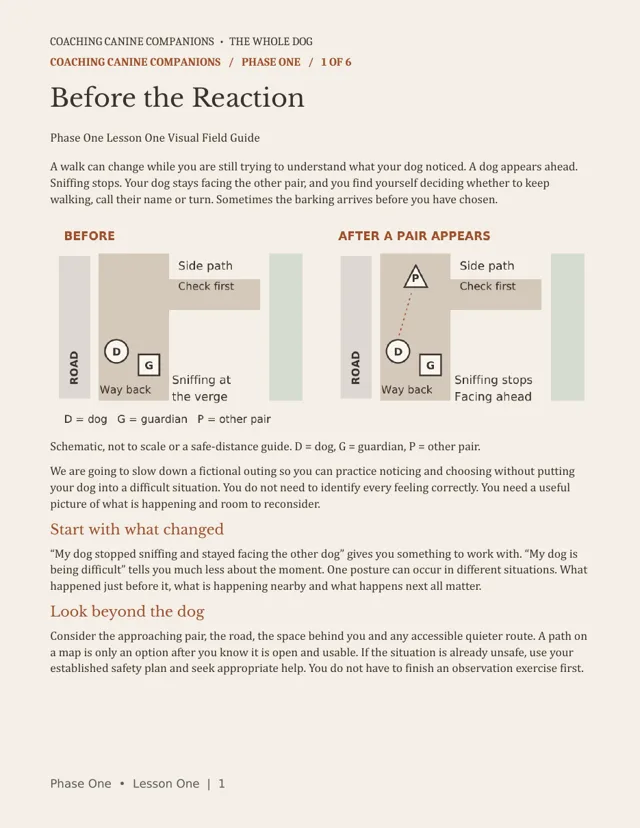
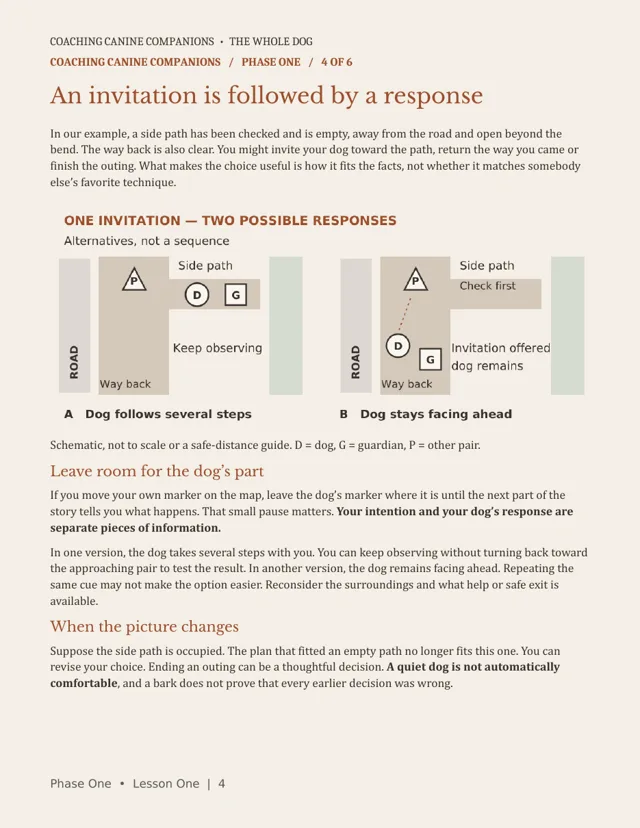
Six illustrated pages that slow one ordinary walk down to the moment the sniffing stops, so you can practice noticing and choosing without putting your dog into a hard encounter.
- What changed first, and why that sentence is more useful than “my dog is being difficult.”
- How to tell a route that looks open from a route you can actually use.
- Why your invitation and your dog’s response are two separate events.
- One small observation to carry home on your next ordinary walk.
Where should I send it?
While it opens, here is a short look inside Phase One.
Join the Phase One interest listIf your dog has a bite history, or you are worried about safety right now, a group class is not the right place to begin. Let’s have a chat first, and we will find the right next step together, beginning with a Meet & Greet.
How it changes · Phase One
From noticing to choosing.
Six classes, in order. Each one moves your attention a little earlier, until the moment before the bark becomes a place you can stand in.
Before the Reaction
Learn to see the small changes that come first: pace, where your dog looks, how easily they answer you.
Communication Beyond the Leash
Practice what your body, pace and voice are already telling your dog, so the leash is not the only thing speaking.
Making Room
Practice using distance, angle and timing to give your dog more space while there is still time to use it.
When Familiar Skills Become Difficult
Look at why the things your dog knows well at home can slip out of reach outside, and how to ask in ways your dog can still answer.
Beyond Wearing Your Dog Out
Explore what, besides more exercise, helps a body arrive at the walk with room to spare.
Finding Your Way Back
Practice what to do after a hard moment, so one difficult encounter does not decide the rest of the walk.
After the hard moment · Phase Two
The walk ended an hour ago. Your dog is still out there.
There is a second hard part, and fewer people talk about it. The door is closed and the leash is on its hook, yet your dog has not landed. They pace, or watch the window, or lie down and get up again. And you hover nearby, unsure whether to help or to leave them be.
Coming Home and Recovery
Learn what recovery looks like in your own dog, and how long it really takes.
Helping Without Adding More
Practice telling the difference between help that settles and help that becomes one more thing to process.
Invited Touch and the Right to Leave
Practice offering contact your dog is free to accept or decline, and reading the answer.
Recovery Through Gentle Movement
Explore when quiet, gentle activity helps a body come back to itself.
Choosing the Next Step
Practice deciding when to offer gentle activity, invite contact, or leave more room.
A Recovery Rhythm for Ordinary Life
Build a simple rhythm that gives recovery a place in an ordinary week.
Permission-based bioenergy balancing is part of the teaching, not a promise of medical treatment.
Which one is yours
Start with your hardest moment.
Each phase stands on its own, and neither is required before the other. Choose by the part of the day that asks the most of you.
Phase One
If the hardest part is before the reaction
$420 six live classes
nine teaching hours
Wednesday evenings from Dec 9
Reactive and highly anxious dogs: seeing the moment before the bark, and what you can do while there is still room.
Join the Interest ListPhase Two
If the hardest part is the long way back to calm
$420 six live classes
nine teaching hours
Saturday mornings from Dec 12
Passive and active recovery: what helps after the hard moment, and when to step back.
Join the Interest ListBoth phases
If it is both · The Whole Dog, complete
$780 twelve live classes
eighteen teaching hours
Saving $60 against $840 separately
The moment before, and the long way back, with the learning materials for both phases.
Join the Interest ListEnrollment is for a complete six-class phase, or both phases, rather than drop-ins.
How the learning works
What comes with each phase.
- Six live classes with me, 90 minutes each, in a small group. The situations you bring shape the conversation.
- Written teaching articles to read at your own pace and return to when you need them.
- Audio versions of the articles for the days when listening fits better than reading.
- Cinematic teaching videos, prerecorded and separate from the live classes.
- Learning handouts: Illustrated Field Guides, private worksheets with sample answers, fillable Accountability Check-ins, Reader Versions, visual examples with text equivalents, and a six-chapter phase book.
- An emailed debrief after each live session, gathering what we worked through, written for the group.
The live sessions are not recorded. Private worksheets stay private, and sending a check-in does not promise individual feedback or private consultation.
Your teacher
Lorrie J. Harris
If we have worked together, you know how much I care about what happens before a behavior becomes obvious: the small change in a dog’s body, the pace of the person beside them, the question that becomes clearer when we take our time.
“What usually changes first is not the dog. It is where you look.”
Lorrie J. Harris, founder of Coaching Canine Companions
U.S. Navy veteran · Dogs since 1990 · Master Dog Trainer through National K-9 · AKC Approved CGC Evaluator · AKC Fit Dog Certified · North Kingstown, Rhode Island
Dates and times
Two schedules, December into January.
Each class is live online and runs 90 minutes. Phase One meets on Wednesday evenings. Phase Two meets on Saturday mornings. Either phase may be taken on its own, and both schedules are set.
Phase One · Wednesday evenings
Reactive and highly anxious dogs · $420 · 6:00–7:30 p.m. Eastern · No class December 23
| Class | Date | Time (Eastern) |
|---|---|---|
| 1 | Wed, Dec 9, 2026 | 6:00–7:30 p.m. |
| 2 | Wed, Dec 16, 2026 | 6:00–7:30 p.m. |
| — | Wed, Dec 23, 2026 | No class |
| 3 | Wed, Dec 30, 2026 | 6:00–7:30 p.m. |
| 4 | Wed, Jan 6, 2027 | 6:00–7:30 p.m. |
| 5 | Wed, Jan 13, 2027 | 6:00–7:30 p.m. |
| 6 | Wed, Jan 20, 2027 | 6:00–7:30 p.m. |
Phase Two · Saturday mornings
Recovery / Bioenergy · $420 · 10:00–11:30 a.m. Eastern · No class December 26
| Class | Date | Time (Eastern) |
|---|---|---|
| 1 | Sat, Dec 12, 2026 | 10:00–11:30 a.m. |
| 2 | Sat, Dec 19, 2026 | 10:00–11:30 a.m. |
| — | Sat, Dec 26, 2026 | No class |
| 3 | Sat, Jan 2, 2027 | 10:00–11:30 a.m. |
| 4 | Sat, Jan 9, 2027 | 10:00–11:30 a.m. |
| 5 | Sat, Jan 16, 2027 | 10:00–11:30 a.m. |
| 6 | Sat, Jan 23, 2027 | 10:00–11:30 a.m. |
Tell me which class interests you.
Choose one phase, choose both, or ask me to help you choose, and you will hear about the classes you selected.
A few things you may be wondering
Questions about The Whole Dog.
What is The Whole Dog?
The Whole Dog is a series of small live online classes taught by Lorrie J. Harris of Coaching Canine Companions. Phase One, for guardians of reactive and highly anxious dogs, is six 90-minute classes on Wednesdays from 6:00 to 7:30 p.m. Eastern, beginning December 9, 2026. Phase Two, on passive and active recovery, is six 90-minute classes on Saturdays from 10:00 to 11:30 a.m. Eastern, beginning December 12, 2026.
When does Whole Dog Phase One meet?
Phase One meets on Wednesdays from 6:00 to 7:30 p.m. Eastern on December 9, 16, and 30, 2026, and January 6, 13, and 20, 2027. There is no class on December 23.
When does Whole Dog Phase Two meet?
Phase Two meets on Saturdays from 10:00 to 11:30 a.m. Eastern on December 12 and 19, 2026, and January 2, 9, 16, and 23, 2027. There is no class on December 26. Either phase may be taken on its own.
How much does The Whole Dog cost?
Phase One is $420 for six 90-minute live virtual classes. Phase Two is $420 for six 90-minute live virtual classes. Both phases together are $780 for twelve classes and eighteen teaching hours, saving $60 compared with $840 separately.
Who teaches The Whole Dog, and how are the classes held?
Lorrie J. Harris of Coaching Canine Companions teaches every session herself, live and online. Each phase is six 90-minute virtual classes in a small group; Phase One is limited to around a dozen guardians. Your dog does not have to perform on camera.
Do I need to take Phase One before Phase Two?
No. Each phase stands alone, and Phase One is not a prerequisite for Phase Two. Enrollment is for a complete six-class phase, or both phases, rather than drop-ins.
Are Whole Dog classes recorded?
No. The live sessions are not recorded. Separately, each phase includes written teaching articles, audio versions of the articles, cinematic teaching videos, learning handouts, and an emailed debrief after each live session. The teaching videos are prerecorded and are not recordings of the live sessions. The debrief is not personalized private coaching.
Is The Whole Dog the same as Canine Sensory Connection?
No. Canine Sensory Connection is self-paced learning at home, with no calls. The Whole Dog is a separate series of live virtual classes. You do not need one before the other.
Is there something free I can start with?
Yes. Before the Reaction is a free six-page Visual Field Guide from Phase One, Lesson One, written by Lorrie J. Harris. Ask for it here and it opens right away.
What if my dog has a bite history?
A group class is not the right place to begin. Let’s have a chat first, and we will find the right next step together, beginning with a Meet & Greet.
Can I enroll now?
Not yet. Both schedules are confirmed: Phase One begins Wednesday, December 9, at 6 p.m. Eastern, and Phase Two begins Saturday, December 12, at 10 a.m. Eastern. Enrollment details are still to come. Joining the interest list does not take payment, enroll you, or reserve a place.
Will The Whole Dog change my dog’s behavior?
The Whole Dog is a series of educational live online classes with Lorrie J. Harris. It teaches guardians what to notice and what choices are available before and after a hard moment. It is not a guarantee of any particular behavior outcome, and it is not veterinary or medical treatment. In Phase Two, permission-based bioenergy balancing is part of the teaching, not a promise of medical treatment.
Also from Coaching Canine Companions
Prefer to learn at home, at your own pace?
Canine Sensory Connection is a six-month, self-paced online scent work program for anxious, reactive, and restless dogs. The 90-Day Field Immersion offers structured work on everyday handling and behavior.
Explore Canine Sensory Connection →Explore the 90-Day Field Immersion →
Not sure which fits? Ask me first.
The Whole Dog is educational. It is not a guarantee of any particular behavior outcome, and it is not veterinary or medical treatment.